
5 Best Dog Harnesses for Senior Dogs with Mobility Loss


5 Best Dog Harnesses for Senior Dogs with Mobility Loss
As an Amazon Associate, Herb and Fur earns from qualifying purchases. This page contains affiliate links, which means that if you choose to buy through one of the links below we may earn a small commission at no additional charge to you. We only write about products we have researched in the live listings, and a commission never changes how a harness is described here.
When an older dog starts to slow down, the change is rarely dramatic. One week the back legs are a little unsteady on the stairs, a few weeks later the dog needs a hand getting out of the car, and eventually you are looking for a way to take some of the weight yourself without hurting either of you. A well-fitted mobility harness does exactly that job: it gives you a safe place to hold on, and it spreads that support across the dog’s chest and belly rather than pulling on the neck.
The five harnesses below were chosen from live Amazon listings for this specific problem, not for general walking. Each one publishes its own sizing method, its own hardware and its own safety or care text, and those details are reported here as the listings publish them. Nothing in this article is medical advice. If your dog is losing mobility, is dragging a limb, or is suddenly unable to stand, that is a conversation to have with your veterinarian first, because a harness may help you support a dog safely but it cannot diagnose or treat the reason for the weakness.
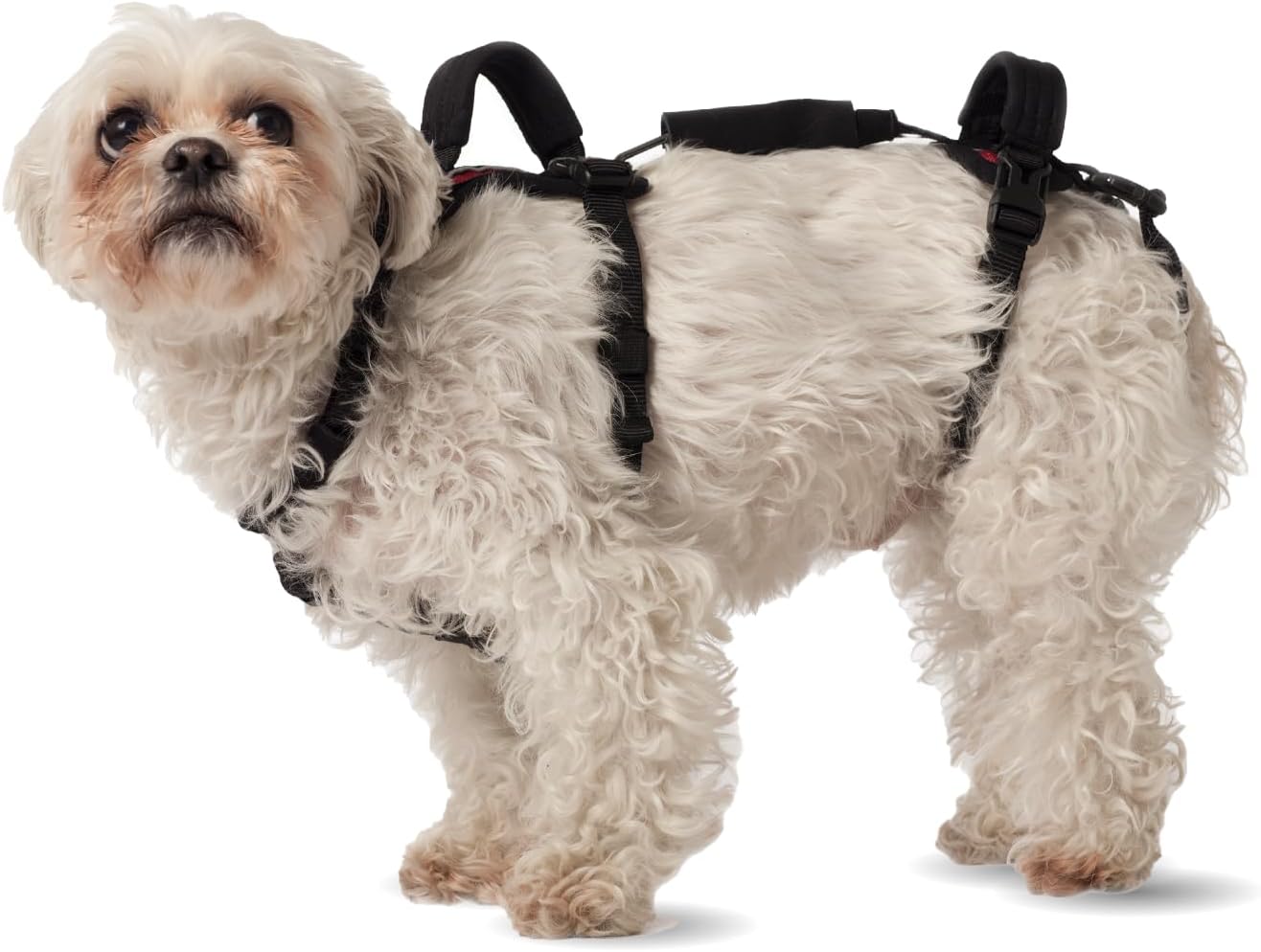
Quick Picks: Five Harnesses at a Glance
The table below is the short version. Every harness in it is linked to its live Amazon listing so you can check the current sizing chart and availability directly, because sizing details and stock change often.
| Pick | Harness | Best for | Sizing basis published |
|---|---|---|---|
| Best overall full-body support | Help ‘Em Up Dog Lift Harness | Dogs who need steady hip and hind-end support on stairs and during potty breaks | Body weight bands from 10 lbs to 225 lbs |
| Best escape-resistant lift assist | Ruffwear Web Master Harness | Dogs who back out of other harnesses and still want to walk | Girth measurement across five sizes |
| Best for male dogs | Lafoty Dog Lift Harness for Large Male Dogs | Male dogs who need rear-leg support without interference when toileting | Chest, neck, back and upper thigh measurements |
| Most configurable | OneTigris Invictus Dog Lift Harness | Handlers who want detachable straps and several carry positions | Neck, chest and back plus body weight bands from 18 lbs to 180 lbs |
| Best simple padded sling | Coodeo Dog Lift Harness | Straightforward support for lifting and stabilising a dog that has lost balance | Body weight bands from 0 lbs to 120 lbs plus girth measurements |
How We Chose These Harnesses
Every harness here had to satisfy a few practical tests before it made the list. First, it had to be sold as a mobility or lift aid rather than as a plain walking harness, which means the listing itself talks about support, lifting or assisting a dog rather than only about pulling and leash control. Second, it had to publish a real sizing method, whether that is a body weight band, a girth measurement or both, because a harness that cannot be matched to a specific dog is not much use. Third, it had to publish enough detail for a buyer to understand the hardware and the construction, from metal D-rings and snap hooks to padded chest panels and rear leg straps.
We also looked at what buyers actually report. Amazon publishes a recurring-theme review summary on many listings, and where that summary existed we noted the themes and the number of customers who mentioned each one. Where a listing did not publish that summary, no theme counts are claimed for it here, rather than guessing from a handful of reviews. Two listings in this group contained internal contradictions, and those are flagged in the product sections instead of being quietly smoothed over.
Finally, a note on what this list is not. These are not veterinary devices. A mobility harness may help you support a dog that has hind-leg weakness, and it may make stairs, cars and potty breaks easier for both of you, but it does not treat the underlying cause of that weakness. Talk to your veterinarian about the cause and about how much weight you should be taking through a harness for your individual dog.
What to Look For in a Harness for a Senior Dog
The needs of an older dog are different from those of a young, athletic one, and the differences show up in the details of the harness rather than in its colour.
- Handles, and more than one of them. A single back handle is enough to steady a dog, but a second handle nearer the shoulders or the hind end gives you a place to hold when you are lifting the rear of a dog that cannot push up on its own.
- Support under the body, not around the throat. A senior dog with a stiff neck or a sensitive airway does best with a harness that carries load on the chest and belly. Several listings here describe a separate front chest piece or a padded belly panel for exactly that reason.
- Hardware that is rated for lifting. Stainless steel D-rings, reinforced stitchwork and metal snap hooks appear in the listings that expect to take a dog’s weight. Plastic buckles are lighter but are not always described as load-bearing.
- Toileting clearance. This matters more than most buyers expect. Some harnesses place their rear straps so a male dog can urinate without soaking the webbing, and some leave the rear straps detachable so they can be removed when the dog is not being lifted.
- A published sizing method, ideally weight and girth together. Several listings in this group publish a full size chart with a pet weight band, and two of them warn that if the dog falls between sizes you should choose the larger one, while one warns you to choose the smaller one. Follow the specific listing you are buying from.
1. Help ‘Em Up Dog Lift Harness, Full Support
The Help ‘Em Up harness is the most explicitly built around hind-end support in this group. The listing describes a full-body lifting harness with what it calls a patented hip lift technology, and it says the design distributes the dog’s weight in a way that avoids pressure or stress on the ligaments, joints, abdomen and bladder. For a dog that needs its back half carried rather than just steadied, that is the feature that matters most.
The listing publishes a clean weight-based size ladder: X-Small for dogs from 10 to 25 lbs, Small from 25 to 45 lbs, Medium from 45 to 80 lbs, Large from 80 to 125 lbs, and X-Large from 125 to 225 lbs. The material is declared as nylon, and the harness is offered in two styles. The Conventional style is described as optimal for female dogs and most male dogs, while the U-band style is described as best for male dogs whose anatomy is set further back. One practical catch: the X-Small size is only available in the Conventional style.
The manufacturer lists five about-this-item points, covering the cushioned and breathable padding, the hip lift technology, the even weight distribution, assistance on stairs, walks and potty time, and the fact that the harness is aimed at dogs struggling with hind-leg weakness due to aging, injury, arthritis or other disease. Care is limited to a machine wash instruction, and the listing publishes no directions block, no storage text and no legal disclaimer.
Buyers describe the harness in terms of quality and support. Amazon’s recurring-theme summary shows quality mentioned by 47 customers, support by 31, utility by 28, comfort by 18, ease of use by 23, fit by 21, adjustability by 12, and value for money by 25. The same summary notes that while some owners find it easy to put on and adjust, others find it fiddly, and that opinions on value are mixed. That pattern is worth knowing before you buy, because a harness that takes two hands and a calm dog to fit is easier to live with when you know it in advance.
At a glance, the practical strengths and limits look like this.
- Strongest point: published weight bands run all the way to 225 lbs, and the hip lift is the point of the design.
- Catch to plan for: two fitting styles, and the smallest size comes in one style only.
- Care: machine wash, per the listing.
- Check current availability and details on the Help ‘Em Up Dog Lift Harness listing, and remember that this listing showed no live featured offer at the time of our research.
2. Ruffwear Web Master Harness
The Ruffwear Web Master is the harness in this group that doubles most comfortably as an everyday walking harness while still offering genuine lift assistance. The listing describes a padded, reinforced lift handle built into the frame for balanced support when lifting a dog, and it names mobility assistance, trail scrambles and helping dogs in and out of vehicles as the intended uses.
Sizing is by girth rather than by weight, measured around the widest part of the rib cage. The published ranges are XX-Small 13 to 17 inches, X-Small 17 to 22 inches, Small 22 to 27 inches, Medium 27 to 32 inches, and Large or X-Large 32 to 42 inches. The listing advises choosing the smaller size when a dog falls between two sizes. The declared material is polyester, and the harness is described as having a chest and belly panel that distributes weight evenly for stable lifting, a fit that resists backing out, an aluminium back V-ring plus a reinforced front clip, and reflective trim for low-light visibility.
There is one internal inconsistency to be aware of. The about-this-item bullets refer to four points of adjustment, while the directions field and the product description both refer to five points of adjustment. The listing also carries a California Proposition 65 warning and a legal disclaimer noting that packaging and materials may contain more or different information than the listing shows.
Care is straightforward: secure the fasteners, hand wash with mild detergent, and air dry. The listing publishes no storage block.
Buyer sentiment on this harness is unusually well documented. Amazon’s recurring-theme summary reports quality mentioned by 858 customers with 819 positive and 39 negative, durability by 409 with 328 positive and 81 negative, fit by 374 with 296 positive and 78 negative, functionality by 299 with 281 positive and 18 negative, comfort by 263 with 215 positive and 48 negative, escape-proof performance by 253 with 243 positive and only 10 negative, the handle by 192 with 190 positive and 2 negative, and value for money by 257 with 175 positive and 82 negative. In plain terms, owners overwhelmingly report that the harness holds a dog securely and that the handle does real work, while the most common complaint is about how much it asks you to spend.
Practical strengths and limits:
- Strongest point: escape resistance and a load-bearing handle, with the highest volume of positive review mentions in this group.
- Catch to plan for: girth-based sizing only, and the listing itself contradicts on four versus five adjustment points.
- Care: hand wash with mild detergent and air dry.
- Availability: this listing showed no live featured offer at the time of our research, so check the current status on the Ruffwear Web Master listing before you plan around it.
3. Lafoty Dog Lift Harness for Large Male Dogs
This is the harness to consider if the dog you are supporting is male and the rear-leg straps of other harnesses have caused a mess at potty time. The Lafoty listing builds its whole pitch around that problem. It says the lift handles do not interfere with male genitalia so the dog can urinate comfortably, and that the rear leg straps are positioned to avoid interference when the dog defecates.
The design is described as a two-in-one full body harness. The rear leg support detaches so the harness can be worn as a regular harness, and the lift strap provides extra mobility support or temporary carrying assistance for stairs, walks or general lifting. The listing counts four strategically placed handles at the front and back, six adjustable straps, and nine clasps across the neck, body and back legs, with a neck buckle so the harness does not have to go over the dog’s head. The declared material is polyester, and the package is listed at just over two pounds.
Sizing is by measurement rather than by weight. For size Medium the listing gives a chest girth of 24 to 29 inches, a neck girth of 17 to 20 inches, a back length of 17 to 20 inches and an upper thigh of 18 to 26 inches. For Large it gives a chest of 27 to 34 inches, a neck of 19 to 23 inches, a back of 19 to 23 inches and an upper thigh of 19 to 28 inches. For X-Large it gives a chest of 32 to 39 inches, a neck of 23 to 27 inches, a back of 21 to 27 inches and an upper thigh of 20 to 30 inches. The sling length is listed as 33 to 55 inches across all three sizes. No body weight band is published, so the listing instead tells buyers to measure the neck, chest and belly and to choose the larger size when a dog falls between sizes.
The only entry in the directions field is a short one, medium and large dog, so the real fitting guidance lives in the safety text. That text is a four step sequence worth repeating: secure all buckles fully, adjust all straps evenly until the harness fits snugly and stays positioned, apply gentle tension to confirm the buckles and straps remain secure and the harness does not shift, and then lift slowly and steadily with smooth controlled movements rather than a sudden pull. The listing adds a reminder not to use the harness at all if any buckle, strap, handle or stitching is damaged. It publishes no storage block.
On reviews, Amazon’s recurring-theme summary reports quality mentioned by 76 customers with 74 positive and 2 negative, life-saving by 43 with all 43 positive, functionality by 46 with 41 positive and 5 negative, support by 37 with 34 positive and 3 negative, ease of use by 34 with 22 positive and 12 negative, fit by 43 with 27 positive and 16 negative, adjustability by 25 with 17 positive and 8 negative, and value for money by 25 with 19 positive and 6 negative. The summary is candid that customers disagree on fit, ease of use and adjustability, which fits the picture of a harness with a lot of straps to set up once and then leave alone.
- Strongest point: a male-dog-specific layout plus a detachable rear support that lets the same harness do two jobs.
- Catch to plan for: no weight band, so you must measure, and buyers report the multi-strap setup is fiddly at first.
- Care: none published beyond general durability claims.
- Details and current availability are on the Lafoty Dog Lift Harness listing.
4. OneTigris Invictus Dog Lift Harness
The OneTigris Invictus is the most configurable harness in this group, and that flexibility is its whole argument. The listing describes a full body lifter for back legs with both horizontal and vertical handles, detachable rear leg straps with anti-chafing sleeves, and an additional utility strap that can be used as a shoulder sling, as a simple leash, or as a harness lifting strap.
The structure is described as a 360 degree support design with a separate front chest piece for even weight distribution, adjustable straps, three grab handles and rear leg straps. The hardware is called out specifically, with stainless steel D-rings and reinforced stitchwork for strength and zinc alloy snap hooks so the straps can be removed or reconfigured for different uses. The declared material is nylon, and the listing names a lifting sling among the included components.
Sizing is published both as a chart and as a body weight band. Size Small is listed for 18 to 32 lbs, with a chest girth of 20 to 27 inches, a neck of 14 to 20 inches and a back length of 15.5 inches. Medium is 30 to 60 lbs, chest 24 to 32 inches, neck 16 to 23 inches, back 17.5 inches. Large is 60 to 90 lbs, chest 27 to 36 inches, neck 18 to 25 inches, back 20 inches. X-Large is 85 to 140 lbs, chest 31 to 40 inches, neck 20 to 29 inches, back 22 inches. XX-Large is 140 to 180 lbs, chest 35 to 44 inches, neck 23 to 33 inches, back 23.5 inches.
There is a discrepancy to flag. The sizing bullet inside the about-this-item section gives size Small a neck girth of 11 to 17 inches and a chest girth of 15 to 22 inches, which does not match the size chart table for the same size. It is worth measuring your dog and comparing against both figures, or asking the seller, if your dog sits near the bottom of the Small band.
The published directions run through four steps: adjust the harness with the adjustable straps so it is snug but not too tight, use the detachable rear leg straps for additional support if needed, use the three grab handles while keeping the weight distribution even, and remove the harness when it is not in use, especially during sleep, to prevent discomfort or chafing. Care is listed as hand wash only, and the listing also permits machine wash. It publishes no safety block and no storage block.
The recurring-theme summary covers quality mentioned by 235 customers, functionality by 104, supportive performance by 104, life-saving by 91, fit by 82, ease of use by 77, comfort by 79, and secure fit by 64. The summary notes that some owners find it highly comfortable while others find it uncomfortable, and that a common complaint is that the back straps do not stay in place. That is consistent with the harness’s design, which relies on several removable strap elements rather than a single fixed body panel.
- Strongest point: hardware and configurability, from metal D-rings to a utility strap that doubles as a shoulder sling.
- Catch to plan for: conflicting size figures for the smallest size, and reports that the back straps can shift.
- Care: hand wash only per the care field, with a machine wash option also listed.
- See the OneTigris Invictus Dog Lift Harness listing for the current size chart and availability.
5. Coodeo Dog Lift Harness
The Coodeo harness is the simplest and most sling-like of the five picks, and it is the one to look at if you want padded support and a hand hold without a lot of strap management. The listing describes it as a pet support and rehabilitation sling lift with adjustable padded breathable straps, aimed at old, disabled, arthritic or unstable dogs.
It is the only harness in this group that publishes a full weight and measurement chart from the smallest end upward. X-Small covers 0 to 20 lbs with a chest girth of 13 to 16 inches, a neck of 15.6 inches and a back length of 10.5 inches. Small covers 21 to 30 lbs, chest 18 to 20 inches, neck 18 inches, back 12.5 inches. Medium covers 35 to 45 lbs, chest 22 to 25 inches, neck 22 inches, back 13.5 inches. Large covers 46 to 65 lbs, chest 26 to 29 inches, neck 26 inches, back 15 inches. X-Large covers 66 to 110 lbs, chest 30 to 35 inches, neck 21.4 inches, back 17 inches. XX-Large covers 111 to 120 lbs, chest 36 to 39 inches, neck 34 inches, back 19 inches. One oddity in that table is the neck figure for X-Large, which is lower than the figure for Large; measure your own dog rather than relying on a single column.
The declared material is a blend of about one fifth spandex and four fifths polyester. The about-this-item points describe breathable soft material intended for long wear, a detachable belt whose length can be adjusted to suit handlers of different heights, a design that takes care of male dogs’ private parts without affecting normal excretion, and assistance on stairs without slipping out. The care instruction in the structured field is machine wash, while one of the bullets says to hand wash with cold water and dry naturally, so treat the gentler instruction as the safer default. The listing publishes no directions block, no safety block, no storage text and no legal disclaimer.
Amazon’s recurring-theme summary shows quality mentioned by 521 customers, functionality by 308, life-saving by 219, ease of use by 170, support by 166, sturdiness by 142, comfort by 126 and fit by 421. The same summary notes that some owners find it fits perfectly while others say it does not suit large dogs, which lines up with the fact that its weight ladder tops out at 120 lbs and its largest sizes are quite specific about girth.
- Strongest point: a complete weight and girth chart, padded construction and a straightforward lift-and-steady design.
- Catch to plan for: the top end of the weight range is limited, and the care instructions conflict between the field and the bullet.
- Care: machine wash per the structured field, hand wash cold and air dry per the bullet.
- Check the Coodeo Dog Lift Harness listing for the live size chart.
More Mobility Harnesses Worth a Look
The five picks above cover the mainstream designs, but three more listings are worth knowing about, because each solves the problem differently.
The ROZKITCH rear-leg lifting harness is a true rear sling rather than a full body harness. It wraps only the back legs, with a soft fleece lining against the midsection and an elastic strap that attaches to the dog’s collar to hold the leg loops in place. Its published sizes run Small with a leg girth of 13.3 to 18.1 inches and a weight band of 22 to 38.5 lbs, Medium with a leg girth of 17.3 to 22 inches and 33 to 71.6 lbs, and Large with a leg girth of 21.2 to 27.5 inches and 66 to 99.2 lbs. The listing is explicit that it is not for puppies, small dogs or super large dogs, and it tells buyers to choose by hind-leg measurement rather than by weight. Review themes there are modest in volume, with fit mentioned by 16 customers alongside 13 for functionality and 12 for recommendation, and the summary notes mixed views on fit and support. Note that the words help em up appear in that listing’s title, but the manufacturer is ROZKITCH, so it is not the brand-name harness described earlier.
The Dollephi dog lift sling carrier takes a different approach again, with independently removable front and back sections and dual front and rear handles. Its published sizing is Medium with a chest girth of 14 to 23 inches and a back length of 14.5 to 16 inches, Large with a chest of 20 to 27 inches and a back of 17 to 19.5 inches, and Extra Large with a chest of 22 to 32 inches and a back of 18.5 to 21 inches. No body weight band is published. The listing is unusually direct about safe wear time, advising no more than four hours at a time and removal before the dog sleeps so the skin can breathe. Care is hand wash only. Review volume is small, with quality mentioned by 26 customers, functionality by 17 and lifting assistance by 15, and mixed feedback on sizing.
The Best Friend Mobility Pro full-body lifting harness is supplied as a front harness and a rear harness that work together, in a breathable mesh and nylon build, with adjustable straps and a two year manufacturer warranty listed. Its listing does not publish a size chart, a weight band or any girth measurements, and it does not publish a recurring-theme review summary either, so the only sizing guidance available is the selected size on the page plus variation labels for Extra Small through Large. If you need weight-based sizing, this is the one listing here that will not give it to you, and it may be worth confirming measurements with the seller before ordering. Care is machine wash and air dry, and the only entry in the directions field is the phrase use responsibly.
How to Measure Your Senior Dog
Getting the size right matters more on a mobility harness than on a walking harness, because a loose harness shifts under load and a tight one rubs where the dog is already sensitive. Set aside a few minutes, use a soft tape measure, and if your dog can stand comfortably, measure in a standing position.
- Body weight. A current weight, taken at the vet if possible, is the starting point for the harnesses that publish weight bands. A dog that has lost weight recently may need a smaller size than its old measurements suggest.
- Chest or girth. Run the tape around the widest part of the rib cage, just behind the front legs, and keep it snug without compressing the coat.
- Neck. Measure around the base of the neck where the harness collar section will sit, not up near the throat.
- Back length. Measure from the base of the neck to the base of the tail along the spine.
- Hind leg or upper thigh. For a rear sling, measure around the top of the hind leg. The ROZKITCH listing asks for exactly this, and says to size by this measurement rather than by weight.
Write the numbers down before you order, and compare them against the specific size chart on the listing you are buying from, because the sizing language is not standardised between brands. Where a listing publishes both a chart and a bullet of sizing text, compare both, as at least one harness in this group has figures that disagree between the two.
Fitting, Care and Storage
Fit a mobility harness the way you would fit a piece of safety equipment: snug enough that it cannot slide around under load, loose enough that you can still slide two fingers under the webbing at the chest. Put it on a calm dog, fasten every buckle fully, then walk the dog a few steps and check again, because straps settle once the dog moves.
Care instructions differ between the listings here, and it is worth following the gentler of the instructions when a listing gives two. The Coodeo harness lists machine wash in its structured care field while a bullet advises hand washing in cold water and drying naturally. The Help ‘Em Up harness lists machine wash. The OneTigris harness lists hand wash only and also allows machine wash. The Dollephi harness lists hand wash only. The Best Friend Mobility harness lists machine wash and air dry. The Ruffwear Web Master asks you to secure the fasteners, hand wash with mild detergent and air dry, and the Lafoty listing publishes no care text at all.
On storage, none of the eight listings read for this article publishes a storage-temperature or storage-location block. Practical storage for this kind of gear is simple: keep the harness dry, hang it rather than leaving it crumpled in a heap, and check the webbing, stitching and buckles before each use. The Lafoty listing states plainly that a harness should not be used at all if any buckle, strap, handle or stitching is damaged or does not function properly, and that is good advice for any harness regardless of brand.
Safety Notes and When to Talk to Your Veterinarian
A harness is a handling tool, not a treatment. It may help you support a dog that has lost strength in the hind legs, and it may make stairs, the car and potty breaks safer and less painful for both of you, but it does not address why the dog is weak in the first place. Weakness, wobbling, dragging a limb, knuckling over on the paw, or a sudden inability to rise can have several different causes, and the right plan depends on which one applies to your dog. Please have your veterinarian assess your dog before you rely on a harness to manage a mobility change, and ask them how much of the dog’s weight it is safe for you to take through a handle and for how long.
A few handling cautions are worth repeating from the listings themselves. Check every buckle and strap before each lift, and lift smoothly rather than with a jerk, as the Lafoty listing describes. Remove the harness when the dog is resting or sleeping, as both the OneTigris and Dollephi listings advise, so the skin and coat are not under pressure for hours at a time. Do not leave the harness on continuously for very long periods, and check the armpits, belly and groin for rubbing. If your own back is a concern, note that one reviewer of the ROZKITCH sling warned about the strain of holding a dog up for long stretches, which is a reminder that a low handle can be tiring for the handler even when it is comfortable for the dog.
Frequently Asked Questions
Does a mobility harness replace a walking harness? For some dogs it can, and the Ruffwear Web Master and the Lafoty two-in-one design are both built to work as everyday harnesses as well as lift aids. For a dog that needs continuous rear support, a dedicated sling worn only when you are actively helping is often more practical.
How do I know whether to size by weight or by girth? Use whichever figure the listing publishes, and use both when both are given. The Help ‘Em Up harness and the Coodeo harness publish weight bands, while the Ruffwear Web Master publishes girth ranges and the Lafoty harness publishes body measurements only. The ROZKITCH sling asks specifically for hind-leg measurement.
Can I leave a lift harness on my dog all day? The Dollephi listing recommends no more than four hours at a time and removal before sleep, and the OneTigris listing advises removing the harness when it is not in use. Those are sensible limits for any harness that carries load.
What if my dog falls between two sizes? The Lafoty listing says to choose the larger size, while the Ruffwear listing says to choose the smaller size. This is exactly why you should follow the instructions on the specific listing you are buying from rather than a general rule.
Which harness is best for a male dog? The Lafoty listing is the only one in this group that specifically designs around male anatomy, and the Help ‘Em Up harness offers a U-band style for male dogs whose anatomy is set further back. Both listings describe the relevant difference directly.
Final Thoughts
If you take one thing from this page, take the sizing habit rather than the product name. Measure your dog, write the numbers down, and compare them against the chart on the listing you are actually buying, because the harnesses here size by weight, by girth, by hind-leg measurement or by some combination of the three.
For a dog that needs its hind end carried, the Help ‘Em Up Dog Lift Harness is the most purpose-built of the group, with published weight bands that reach 225 lbs. For a dog that still walks but sometimes needs a steadying hand and cannot be trusted not to back out of its gear, the Ruffwear Web Master earns its strong reputation on escape resistance and handle strength. For a male dog, the Lafoty two-in-one lift harness is built around the problem that other harnesses ignore.
Whichever you choose, introduce it slowly, keep sessions short at first, and let your dog tell you whether the fit is comfortable. And if the mobility change is new, or getting worse, make the veterinary appointment before you make the purchase, because the harness will help you manage the day to day while your vet helps you understand what is actually going on.
