
Best Milk Thistle Supplements for Dogs with Liver Issues (2026): 5 Picks for Vet-Guided Liver Support


Affiliate disclosure: Herb & Fur is a participant in the Amazon Services LLC Associates Program. If you buy through links on this page, we may earn a small commission at no extra cost to you. This helps us keep researching natural pet care. Prices and availability on Amazon change frequently — the price you see at checkout is the accurate one.
“Liver issues” is a phrase no dog owner wants to hear at the vet’s office, yet it’s surprisingly common. Maybe your dog has chronic hepatitis that’s being monitored with regular bloodwork. Maybe they’re on long-term medication — seizure control, steroids, pain relief — that the liver has to process every single day. Or maybe they’re recovering after eating something they shouldn’t have, and your vet has suggested supporting the liver while it does its repair work.
That is exactly why so many owners search for the best milk thistle supplements for dogs with liver issues. Milk thistle’s active complex, silymarin, is one of the most widely used liver-support ingredients in veterinary practice, and its partner ingredient SAMe (S-adenosylmethionine) helps the liver maintain glutathione, its own built-in antioxidant defence. One thing to be clear about from the start: these supplements support a liver that is under strain — they do not diagnose anything, and they are never a substitute for finding out why your dog’s liver is struggling. The diagnosis, monitoring and any medication decisions belong to your vet.
We compared the leading Amazon options on silymarin/SAMe content, absorption technology, format, and the quality controls behind each brand — and narrowed it down to these five.
Quick Picks: Top 5 at a Glance
| Product | Best for | Form | Check it |
|---|---|---|---|
| Nutramax Denamarin for Large Dogs | Best overall / vet standard | Coated tablets, 30 ct | Check Price on Amazon |
| Pet Wellbeing Milk Thistle for Dogs | Best pure milk thistle liquid | Liquid drops, 4 fl oz | Check Price on Amazon |
| Rx Vitamins Hepato Support | Best capsule formula | Capsules, 180 ct | Check Price on Amazon |
| Coco and Luna Milk Thistle for Dogs | Best soft chew | Soft chews, 90 ct | Check Price on Amazon |
| VetriScience Vetri SAMe 90 | Best SAMe for small dogs | Enteric tablets, 30 ct | Check Price on Amazon |
Why Milk Thistle and SAMe Are the Two Ingredients Vets Reach For
The liver is your dog’s chemical processing plant: it filters blood, produces bile for digestion, stores energy, and breaks down almost every medication your dog takes. When it’s under strain — from chronic inflammation, a heavy medication load, or a toxic insult it’s recovering from — two nutritional tools come up again and again in veterinary practice.
Silymarin, the active complex in milk thistle seed, is an antioxidant that helps protect liver cells from free-radical damage and supports the liver’s normal repair processes. Its most active component, silybin, is poorly absorbed on its own, which is why the better products pair it with phosphatidylcholine to form a better-absorbed complex. SAMe works on a different pathway: the liver uses it to make glutathione, the antioxidant it relies on to neutralise the substances it processes. Dogs with compromised livers often can’t make enough of either fast enough, which is why the two ingredients are so frequently used together.
Neither ingredient treats hepatitis, removes toxins in an emergency, or replaces prescribed drugs such as ursodiol, antibiotics or lactulose. Think of them as nutritional backup for an organ doing hard work — chosen with your vet, and judged by follow-up blood tests, not by guesswork.
What to Look for in a Milk Thistle Supplement for a Dog with Liver Issues
- Standardised silymarin, honestly stated: Look for milk thistle extract standardised for silymarin content, or a stated silybin amount per serving. Plain ground herb with no standardisation is a lottery.
- An absorption strategy: Silybin-phosphatidylcholine complex (as in Denamarin) is the best-studied fix for silymarin’s poor absorption. For SAMe, enteric coating matters — it protects the ingredient from stomach acid.
- The right partner ingredients for your dog’s situation: SAMe for glutathione support, B vitamins (the liver stores and activates them), choline and vitamin E are the sensible supporting cast. Long ingredient lists of unrelated herbs are not.
- A format you’ll actually give daily: Liquids suit tiny dogs and pill-refusers; capsules can be opened onto food; chews win on compliance; coated tablets must usually be given whole, on an empty stomach.
- Quality signals: NASC membership, veterinarian-formulated brands, and companies that supply vet clinics are the strongest signals in a category with plenty of lookalikes.
- A vet in the loop: Any dog with actual liver issues should be on a monitoring plan. Recheck bloodwork on your vet’s schedule — that’s how you know whether support is helping.
1. Nutramax Denamarin for Large Dogs — Best Overall, the Vet Standard
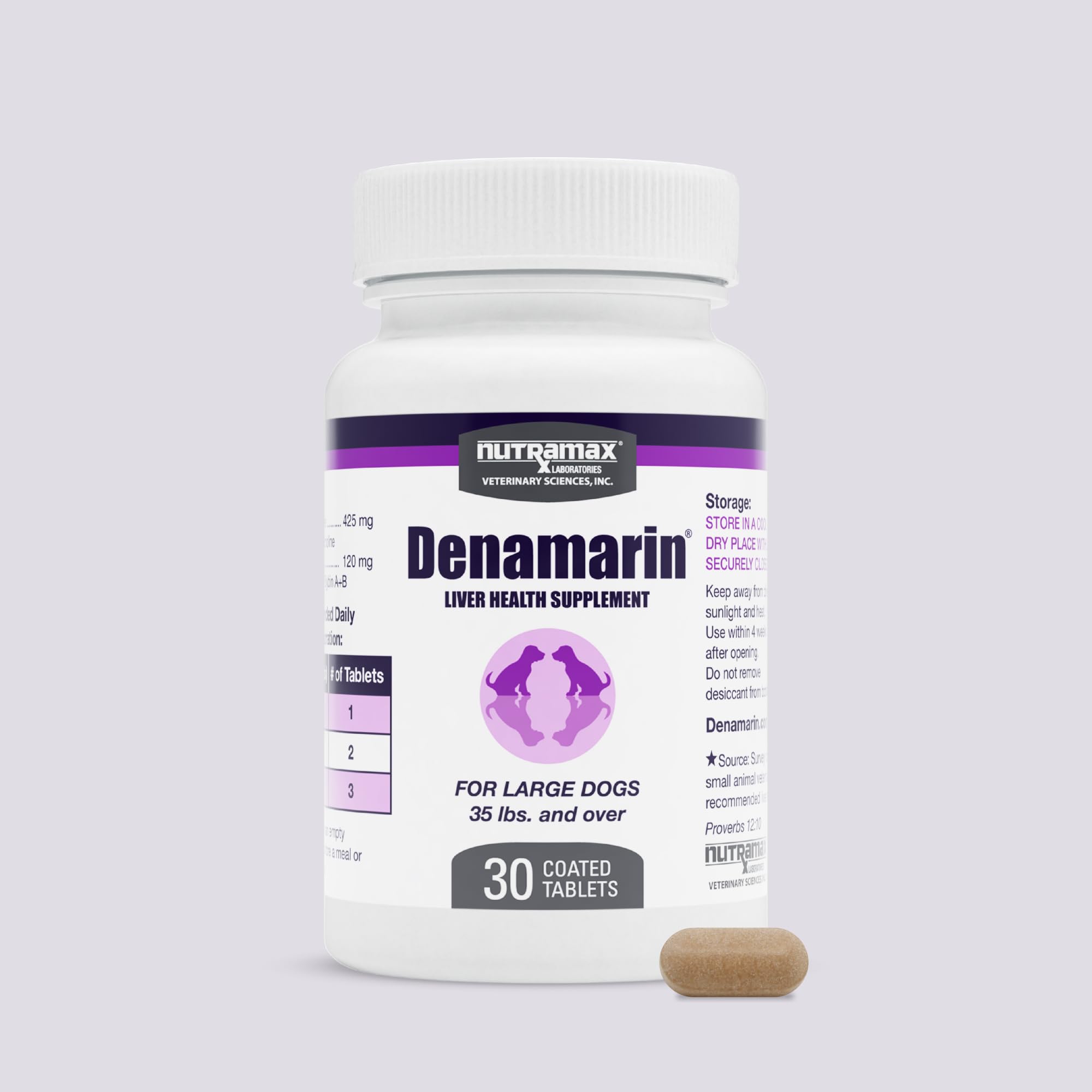
If your vet has said “liver support”, there is a good chance this is the product they had in mind. Denamarin combines 425 mg of SAMe with a silybin-phosphatidylcholine complex providing 35 mg of silybin A+B per tablet in this large-dog size — the SAMe-plus-silybin pairing in a single product, with the phosphatidylcholine complex specifically chosen because silybin is absorbed better that way than as standardised milk thistle extract alone. Nutramax describes it as the #1 veterinarian recommended liver support brand, and it is the name most commonly stocked in clinic pharmacies.
The practical details matter: tablets are given on an empty stomach (at least an hour before food) for proper SAMe absorption, they shouldn’t be split or crushed, and there are sizes for small and medium dogs too — pick the one matched to your dog’s weight band. For a dog already on a vet-led plan for chronic hepatitis or a heavy medication load, this is the most defensible starting point on the list.
Pros: SAMe and enhanced-absorption silybin in one tablet; veterinary-channel brand with decades behind it; sized by weight band; made in the USA.
Cons: Empty-stomach timing takes planning around meals and other meds; tablets can’t be split, so dose flexibility is limited; among the pricier options per month.
Best for: Dogs on a vet-led liver plan — chronic hepatitis, long-term medication, post-toxin recovery — whose owners want the clinic-standard product.
2. Pet Wellbeing Milk Thistle for Dogs — Best Pure Milk Thistle Liquid
Some owners — and some vets — prefer a single-herb approach: milk thistle, nothing else, in a form that’s easy to dose precisely. Pet Wellbeing’s liquid uses certified organic milk thistle seed extract standardised for silymarin, in a natural vegetarian bacon flavour, dosed by dropper according to weight (from 0.5 ml for dogs under 10 lb up to 4 ml for the giants). The 4 fl oz bottle suits medium and large dogs; a 2 oz size exists for small dogs.
Pet Wellbeing is NASC certified, the formula is veterinarian-formulated, and the liquid format is genuinely useful for dogs who spit out tablets or whose dose needs fine-tuning. Because it’s milk thistle only, it layers cleanly alongside a separate SAMe product if your vet wants both pathways covered, without doubling up on anything.
Pros: Certified organic, standardised single herb; dropper dosing suits tiny dogs and fine adjustments; NASC certified and vet-formulated; alcohol-free liquid.
Cons: No SAMe, so glutathione support needs a separate product if your vet wants it; daily dropper dosing is a small chore; herbal taste won’t win over every dog.
Best for: Owners who want a clean, organic milk thistle only — especially for small dogs or as the milk thistle half of a vet-designed combination.
3. Rx Vitamins Hepato Support — Best Capsule Formula
Rx Vitamins is a brand sold through veterinary practices, and Hepato Support is its long-standing liver capsule: milk thistle extract standardised to 80% silymarin (100 mg per capsule) alongside a B-vitamin complex (B1, B2, B6, B12), inositol and dl-methionine. The B vitamins are a thoughtful inclusion — a struggling liver stores and activates them less efficiently, and they’re the supporting cast vets most often mention alongside silymarin.
Dosing is one capsule twice daily per 25–50 lb of body weight, given with or after food, and the capsules can be opened and sprinkled for dogs who won’t swallow them. The 180-capsule bottle makes this one of the more economical vet-channel options for long-term daily use in medium and large dogs.
Pros: Standardised 80% silymarin with a declared 100 mg per capsule; B-complex and methionine included; vet-channel brand; capsules can be opened onto food; big bottle suits long-term use.
Cons: Twice-daily dosing; capsule format is less treat-like than chews; no SAMe in the formula.
Best for: Long-term daily liver support for medium and large dogs, especially where a vet has suggested milk thistle plus B vitamins.
4. Coco and Luna Milk Thistle for Dogs — Best Soft Chew
For the dog who treats every tablet as an insult, Coco and Luna’s soft chews put milk thistle into a treat format: milk thistle alongside choline, L-arginine, and EPA & DHA omega-3s, in a 90-count tub. Choline is a sensible partner — it’s involved in fat metabolism in the liver — and the omega-3s add general support for dogs whose liver issues sit alongside skin or joint complaints, which is common in seniors.
Coco and Luna’s products are veterinarian-formulated and made in the USA in FDA-registered, GMP-certified facilities. The chew format won’t match the concentrated silybin delivery of Denamarin, and it’s not the pick for a dog in a fragile state — but for maintenance support in a stable dog who refuses everything else, the best supplement is the one that actually gets eaten.
Pros: Chew format means excellent daily compliance; choline and omega-3s are thoughtful additions; vet-formulated, clean manufacturing credentials; suitable for all life stages.
Cons: Lower-intensity support than the tablet/capsule picks; contains fish-derived omega-3s, so not for fish-allergic dogs; not a substitute for SAMe where a vet has specified it.
Best for: Stable dogs on maintenance liver support who refuse tablets and capsules — and seniors who’d benefit from the omega-3s anyway.
5. VetriScience Vetri SAMe 90 — Best SAMe for Small Dogs
Vetri SAMe takes the other pathway: 90 mg of SAMe plus L-glutathione itself, in enteric-coated tablets sized for cats and small dogs under 13 lb (a 225 mg version exists for bigger dogs). The enteric coating is the detail that matters — SAMe degrades in stomach acid, and the coating is designed to get it through to where it can be absorbed. VetriScience also notes SAMe may support cognition in ageing small dogs, a genuine side benefit for seniors.
The tablets are unflavoured and small enough to hide in a pill treat, which suits small dogs with sensitive digestion who turn their nose up at flavoured chews. Pair it with the Pet Wellbeing liquid above and you have the full SAMe-plus-silymarin combination in small-dog-friendly formats.
Pros: SAMe plus glutathione in one enteric-coated tablet; sized honestly for small dogs; unflavoured for sensitive stomachs; established vet-formulated brand.
Cons: No milk thistle — pair with a silymarin product for full coverage; enteric tablets must be given whole, ideally on an empty stomach; small-dog sizing means bigger dogs need the 225 mg version instead.
Best for: Small dogs whose vet has prioritised SAMe/glutathione support, and senior small dogs who may get a cognitive bonus too.
Tablets vs. Capsules vs. Liquid vs. Chews: Which Should You Choose?
Coated tablets (Denamarin, Vetri SAMe) deliver the most concentrated, clinic-style support, but come with rules — empty stomach, don’t split. Capsules (Hepato Support) are the flexible middle ground: swallow whole or sprinkle on food. Liquids (Pet Wellbeing) give the finest dose control and suit tiny or tablet-averse dogs. Soft chews (Coco and Luna) trade intensity for compliance. For a dog with diagnosed liver disease, follow your vet’s lead on ingredient and dose first, then choose the format that fits your routine — consistency over months is what liver support is about.
Safety Notes: When Liver Issues Are an Emergency
- See a vet urgently — same day — if you notice: yellowing of the gums, eyes or inner ears (jaundice), repeated vomiting, complete loss of appetite, unusual sleepiness or confusion, head-pressing, wobbliness or disorientation (possible hepatic encephalopathy), a swollen or fluid-filled belly, pale or clay-coloured stools, or very dark orange urine. These are signs the liver is failing to cope, not problems a supplement can address.
- Suspected poisoning is an emergency, full stop. Xylitol (birch sugar), sago palm, certain mushrooms, paracetamol/acetaminophen and some human medications can cause acute liver failure. If your dog may have eaten any of these, contact a vet or poison line immediately — do not wait, and do not rely on milk thistle at home.
- Never stop or swap prescribed liver medication for a supplement. If your vet has prescribed ursodiol, antibiotics, lactulose, steroids or anything else, those drugs are doing work supplements cannot. Stopping seizure medication or other long-term drugs because “the liver needs a break” can be dangerous in itself — raise medication concerns with your vet, who can adjust doses and monitor bloodwork.
- Check for interactions. Milk thistle can affect how the liver processes some drugs, which cuts both ways — tell your vet about any supplement before starting, especially alongside chemotherapy, cyclosporine, or heavy medication loads.
- Give SAMe products on an empty stomach as directed, and keep Denamarin tablets in their blister until use — SAMe is sensitive to moisture and heat.
- Judge results by bloodwork. Liver support is a months-long project. Rechecks on your vet’s schedule tell you whether enzymes and bile acids are moving the right way.
Frequently Asked Questions
Can milk thistle cure my dog’s liver disease?
No. Milk thistle and SAMe support liver cell health and the liver’s own repair and detoxification processes, but they do not cure hepatitis, remove tumours, unblock bile ducts or reverse cirrhosis. The value of these products is as part of a vet-led plan for a diagnosed problem — the diagnosis and monitoring come first.
My dog’s liver issue is caused by their medication. Should I stop the medication and use milk thistle instead?
Never stop a prescribed medication on your own — for drugs like seizure control, stopping suddenly can be life-threatening. This is exactly the situation to discuss with your vet: they may add liver support, adjust the dose, change the drug, or schedule monitoring bloodwork. Liver support supplements exist precisely so that necessary medications can often be continued more safely, not as replacements for them.
How long before liver support supplements make a difference?
Expect weeks to months, not days. Owners sometimes notice appetite and brightness improving first, but the meaningful measure is follow-up blood tests. Most vets recheck liver values after 4–8 weeks on a new support plan and adjust from there — keep giving the supplement consistently in the meantime, and don’t judge it on a good or bad day.
Can I give milk thistle and SAMe together?
Yes — they’re one of the most common pairings in veterinary liver support (Denamarin combines them in a single tablet). They work through different pathways: silymarin as antioxidant cell protection, SAMe supporting glutathione production. If you combine separate products, check labels so you’re not accidentally doubling one ingredient across two supplements.
Is human milk thistle from the pharmacy okay to give my dog?
It’s risky guesswork. Human products vary widely in standardisation and dose, may contain other ingredients unsuitable for dogs, and capsule sizes make accurate dosing for a 6 kg dog nearly impossible. A pet-formulated product with a stated silymarin amount and weight-based dosing is the safer, more honest option — and your vet can verify the dose.
Our Verdict
For most dogs with liver issues, start where the vets start: Nutramax Denamarin pairs SAMe with better-absorbed silybin in one tablet and has the strongest clinical track record. Choose Pet Wellbeing Milk Thistle for a pure, organic, precisely dosed liquid, Rx Vitamins Hepato Support for economical long-term capsule support with B vitamins, Coco and Luna when a chew is the only format your dog will accept, and Vetri SAMe 90 for small dogs whose plan centres on SAMe. Whichever you pick, keep your vet in charge of the plan, never trade prescribed medication for a supplement, and let follow-up bloodwork — not hope — tell you it’s working.
→ See Nutramax Denamarin for Large Dogs on Amazon
{“@context”:”https://schema.org”,”@type”:”ItemList”,”name”:”Best Milk Thistle Supplements for Dogs with Liver Issues”,”numberOfItems”:5,”itemListElement”:[{“@type”:”ListItem”,”position”:1,”item”:{“@type”:”Product”,”name”:”Nutramax Denamarin Liver Health Supplement for Large Dogs”,”url”:”https://www.amazon.com/dp/B0BHKP6YLB?tag=herbandfur-20″,”sku”:”B0BHKP6YLB”}},{“@type”:”ListItem”,”position”:2,”item”:{“@type”:”Product”,”name”:”Pet Wellbeing Milk Thistle for Dogs”,”url”:”https://www.amazon.com/dp/B01MCRYAT6?tag=herbandfur-20″,”sku”:”B01MCRYAT6″}},{“@type”:”ListItem”,”position”:3,”item”:{“@type”:”Product”,”name”:”Rx Vitamins Hepato Support for Dogs and Cats”,”url”:”https://www.amazon.com/dp/B0CX6RWYMX?tag=herbandfur-20″,”sku”:”B0CX6RWYMX”}},{“@type”:”ListItem”,”position”:4,”item”:{“@type”:”Product”,”name”:”Coco and Luna Milk Thistle for Dogs”,”url”:”https://www.amazon.com/dp/B0CDY2MYV4?tag=herbandfur-20″,”sku”:”B0CDY2MYV4″}},{“@type”:”ListItem”,”position”:5,”item”:{“@type”:”Product”,”name”:”VetriScience Vetri SAMe 90 Liver Health Tablets”,”url”:”https://www.amazon.com/dp/B002WDZ7Q0?tag=herbandfur-20″,”sku”:”B002WDZ7Q0″}}]}
{“@context”:”https://schema.org”,”@type”:”FAQPage”,”mainEntity”:[{“@type”:”Question”,”name”:”Can milk thistle cure my dog’s liver disease?”,”acceptedAnswer”:{“@type”:”Answer”,”text”:”No. Milk thistle and SAMe support liver cell health and the liver’s own repair and detoxification processes, but they do not cure hepatitis, remove tumours, unblock bile ducts or reverse cirrhosis. They are part of a vet-led plan for a diagnosed problem.”}},{“@type”:”Question”,”name”:”My dog’s liver issue is caused by their medication. Should I stop the medication and use milk thistle instead?”,”acceptedAnswer”:{“@type”:”Answer”,”text”:”Never stop a prescribed medication on your own. Discuss it with your vet, who may add liver support, adjust the dose, change the drug, or schedule monitoring bloodwork. Supplements exist so necessary medications can often be continued more safely, not as replacements.”}},{“@type”:”Question”,”name”:”How long before liver support supplements make a difference?”,”acceptedAnswer”:{“@type”:”Answer”,”text”:”Expect weeks to months. The meaningful measure is follow-up blood tests; most vets recheck liver values after 4-8 weeks on a new support plan.”}},{“@type”:”Question”,”name”:”Can I give milk thistle and SAMe together?”,”acceptedAnswer”:{“@type”:”Answer”,”text”:”Yes. They are a common pairing in veterinary liver support and work through different pathways: silymarin as antioxidant cell protection, SAMe supporting glutathione production. Check labels to avoid doubling an ingredient across products.”}},{“@type”:”Question”,”name”:”Is human milk thistle from the pharmacy okay to give my dog?”,”acceptedAnswer”:{“@type”:”Answer”,”text”:”It is risky guesswork: human products vary in standardisation and dose and make accurate dosing for small dogs difficult. A pet-formulated product with a stated silymarin amount and weight-based dosing is safer.”}}]}
